

NIT Self-Employment Guide Kenya · 2026
Best Courses for
Self-Employment in Kenya
Learn a skill · prove it · sell it
Compare practical, beauty, ICT and technical courses by what you can sell, how hard the business is to start, repeat-customer potential and whether you can begin small.
The self-employment route
Which courses are best for self-employment in Kenya?
Strong options include barbering, nail technology, hairdressing, beauty therapy, makeup artistry, graphic design, digital marketing, software development, computer repair, plumbing and electrical installation. The best choice is not simply the course with the biggest income claim. Choose a skill you can perform well, prove to a customer and start at a scale you can realistically afford.
Before paying school fees, ask one practical question: when I finish training, what useful work will somebody pay me to do?
For a barber, the answer is grooming. For a nail technician, it is nail services. A designer sells visual work. A software developer sells solutions such as websites, apps or business systems. That clarity matters more than a course being labelled “marketable.”
Kenya’s informal economy is large. The KNBS 2026 Economic Survey estimates that informal-sector engagement rose to about 18.1 million people in 2025. That figure includes employees as well as business owners, so it should not be read as a self-employment count. It does show how important small enterprises and non-formal economic activity are to Kenyan livelihoods.
Compare the business—not just the course name
Self-employment course comparison for Kenya
This table uses relative startup barriers rather than invented national budgets. Your actual cost depends on the tools you already own, your location, transport, consumables, premises and the service you plan to sell.
| Course / skill | What you can sell | Startup barrier | Repeat clients | Begin small? | Online? |
|---|---|---|---|---|---|
| Barbering | Haircuts and grooming | Low–moderate | Very strong | Yes | No |
| Nail technology | Nail and grooming services | Low–moderate | Strong | Yes | No |
| Hairdressing | Hair styling and treatment | Moderate | Very strong | Yes | No |
| Beauty therapy | Beauty and personal-care services | Moderate | Strong | Yes | No |
| Makeup artistry | Event and personal makeup | Low–moderate | Moderate | Yes | Limited |
| Graphic design | Branding and visual design | Low if equipped | Moderate | Yes | Yes |
| Digital marketing | Marketing services | Low if equipped | Strong with retained clients | Yes | Yes |
| Software development | Websites, apps and systems | Low–moderate if equipped | Moderate | Yes | Yes |
| Computer repair | Diagnosis, repair and support | Moderate | Strong | Yes | Limited |
| Plumbing / electrical | Installation, repair and maintenance | Moderate | Moderate | Yes, when competent | No |
| Welding / fabrication | Fabricated products and repairs | Higher | Moderate | Harder | No |
On a small screen, swipe sideways to see every column.
The answer changes with your goal
Which self-employment course fits what you want to build?
Barbering, hairdressing, nails and selected beauty services are strong because satisfied clients can book again.
Software development, graphic design and digital marketing can serve clients beyond your immediate location.
Digital services, makeup and selected mobile beauty or grooming models may let you test demand before taking on heavy rent.
Computer repair, plumbing and electrical work solve clear customer problems but carry a higher responsibility for correct, safe work.
Heavy-equipment operation can be highly useful as a career, but owning machinery is a different financial decision from learning to operate it. Keep skill cost and business-asset cost separate.
A better way to compare startup difficulty
Three types of self-employment course
Examples: Barbering, makeup artistry, graphic design, digital marketing and software development.
The customer is mainly paying for your ability to produce a result. Tools matter, but the skill is the main asset.
Examples: Hairdressing, nail technology, beauty therapy, computer repair, plumbing and electrical services.
Competence remains central, but a reliable tool kit, consumables or workstation becomes more important.
Examples: Large fabrication workshops, equipment-intensive workshops and heavy-machinery ownership.
The productive assets can become the biggest barrier. A marketable skill is not automatically a cheap business to own.
Ten practical routes worth comparing
Best courses for self-employment in Kenya
The order below is not an earnings ranking. A lower-cost route is not automatically better, and a high-skill digital course is not automatically easier than a practical trade.
Barbering
Clear service, visible results and strong repeat-customer potential. A beginner may gain experience inside an existing shop before owning one.
Repeat clients · practical · gradual startNail technology
Appointment-based work can grow from a focused service into a wider beauty menu. Technique, hygiene and consistent finishing drive referrals.
Appointments · portfolio · beauty routeHairdressing
Strong repeat demand, but the field is broad. Become reliable at a useful set of services before trying to offer everything on a salon menu.
Repeat demand · salon · mobile workBeauty therapy
Several client-service routes can sit under one broader qualification. Rebooking, hygiene and trust matter more than the certificate alone.
Client retention · several servicesMakeup artistry
Event-driven rather than purely walk-in. Build a credible portfolio and referral network before spending heavily on premises.
Events · portfolio · referralsGraphic design
A laptop lowers premises needs only when the designer can solve real communication problems. Your portfolio is the evidence clients judge.
Remote work · branding · portfolioDigital marketing
Sell a business result, not merely “posting.” Retained clients can create recurring work when you can explain and measure what the marketing is meant to achieve.
Retainers · online · measurable workSoftware development
Harder to master, but flexible once you can deliver. Build websites, systems or apps for clients—or eventually create a product used by several customers.
Projects · remote · product potentialComputer repair
Useful local service work when diagnosis is systematic and trustworthy. Customers value correct fault-finding more than random part replacement.
Diagnosis · repair · supportPlumbing & electrical
Clear technical problems create service demand, but mistakes can be costly or dangerous. Proper training, safe practice and applicable requirements come first.
Technical service · safety · site workUseful options beyond the main ten
Other practical self-employment courses worth considering
Tailoring and garment making
Alterations, repairs, uniforms and made-to-measure clothing give the customer a visible product. Finishing quality and delivery time strongly affect referrals.
Welding and fabrication
Gates, frames, doors, repairs and custom metalwork can create independent work, but tools and a suitable working area push the startup barrier higher.
Baking and catering
Cakes, snacks and event food can be sold directly, but selling price is not profit. Ingredients, fuel, packaging, labour, transport, waste and applicable permits all matter.
Keep skill ownership separate from machine ownership
Can plant operator training lead to self-employment?
Yes, but the route needs careful wording. A trained and properly licensed operator can earn through employment or legitimate paid operating assignments without owning the machine.
Training builds the competence needed to operate approved machinery safely.
An operator may earn from employment or paid assignments without buying the machine.
Starting a machinery-hire business is a separate, capital-heavy decision.
The skill can be marketable while ownership of the productive asset remains expensive. That distinction makes the advice more realistic.
Use categories instead of invented national budgets
Which self-employment courses need the least startup capital?
There is no trustworthy universal figure. One designer already owns a suitable laptop; another has to buy one. One barber starts from an existing shop; another wants to fit out an entire premises. Compare the smallest professional version of the service you can realistically start.
Lower barrier
Digital and selected mobile services
Graphic design, digital marketing, software services when already equipped, makeup and selected mobile grooming or beauty models.
Moderate barrier
Tools and consumables matter more
Barbering, hairdressing, nails, beauty therapy, computer repair, plumbing and electrical services.
Higher barrier
Assets dominate the setup
Larger fabrication operations, equipment-intensive workshops and heavy-machinery ownership.
Planning rule: separate what you need to perform the service professionally from what would merely make the business look bigger on day one.
Self-employment does not have to begin after graduation
Can you work first and start a business later?
Yes. In many fields, employment is a useful training ground. It exposes you to real customers, job timing, pricing mistakes, stock control and the standards experienced workers use every day.
That path can also give you time to build contacts and save capital. Self-employment is an option, not a deadline.
A practical decision framework
The NIT self-employment test
Before calling any course a good business course, put it through these five checks.
Can you complete the service?
Not explain it or watch someone else do it. Can you personally perform the work to a standard a real customer would accept?
Can you show proof?
A portfolio, working project, completed haircut, nail set, repair task or other genuine evidence reduces the gap between claiming skill and demonstrating it.
Who exactly will buy it?
“Everyone” is not a market. Identify households, students, salons, shops, schools, contractors, event clients or online businesses that actually need the service.
Can you start at a scale you can afford?
Separate essential professional tools from expensive extras that can wait until real customer demand justifies them.
Can one customer lead to another?
Repeat appointments, referrals, maintenance work and continuing contracts give a small business a mechanism for growth.
Technical skill gets the job done; business skill keeps it viable
What else should a self-employed graduate learn?
The Micro and Small Enterprises Authority’s NYOTA implementation information highlights business planning, financial management, record keeping, customer relations and marketing as part of enterprise support. Those basics matter whatever practical skill you choose.
Know what the service costs before deciding what to charge.
Track money in, money out and stock used.
Good work loses value quickly when communication or reliability is poor.
People who need the service must be able to find and understand your offer.
Ask what happens during the course
What should you check before joining a self-employment course?
| Question | What a useful answer should tell you |
|---|---|
| How much practical work will I personally do? | How often you handle the tools, complete the service or build a project yourself. |
| What should I be able to complete before graduation? | A specific service, product, project or technical task—not a vague promise of “skills.” |
| What tools or equipment will I train with? | Whether the practical environment matches the work you hope to perform later. |
| Is there attachment or real-work exposure? | How the course connects classroom practice to customers, workplaces or real projects. |
| What does the fee cover? | Tuition, kits, consumables, examinations and any costs paid separately. |
| Are there licensing or regulatory requirements? | Any step required before practising independently in safety-sensitive or regulated work. |
| Can I see recent student work? | Real evidence of the practical standard learners are reaching. |
Practical training in Migori Town
Self-employment-friendly skills at Newton Institute of Technology
NIT offers practical programmes that can support employment, project work or future self-employment depending on the learner’s competence and chosen route.
Keep the search intent clear
Self-employment courses vs employable skills: what is the difference?
The two ideas overlap, but they start with different questions. A course can support both routes.
Most employable skills
Main question: Where can this skill create earning opportunities?
The focus is broader: jobs, freelance work, contracts, projects and other ways of earning from the skill.
Courses for self-employment
Main question: What service or product can I sell directly?
The focus is narrower: training that can leave you able to serve customers, take paid projects or gradually build your own income source.
This article owns that decision intent.
Some skills belong to both
Software development, barbering, digital marketing and computer repair can support employment and independent earning. The difference is the question the learner is trying to answer.
Visual summary
Self-employment courses in Kenya at a glance
This infographic brings together the two decisions that matter most in this guide: how difficult the business is to start and how a self-employment course differs from a broadly employable skill.
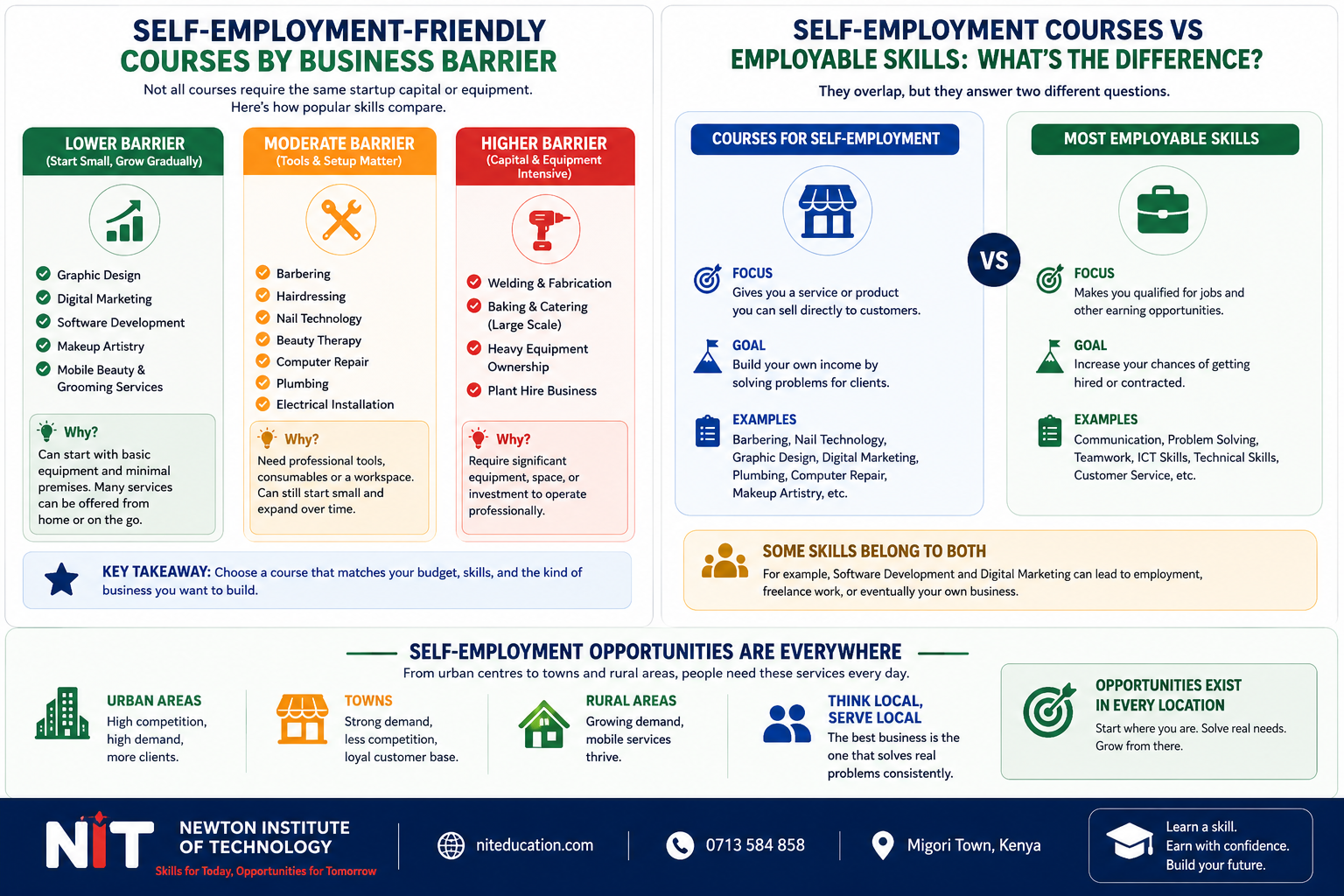
NIT visual guide: lower-, moderate- and higher-barrier routes; self-employment courses versus employable skills; and how the same practical skill can support more than one earning route.
Direct answers to common questions
Courses for self-employment in Kenya: FAQs
Which is the best course for self-employment in Kenya?
There is no single best course for everyone. Barbering, hairdressing, nail technology, beauty services, graphic design, digital marketing, software development, computer repair and several technical trades can all support self-employment. Compare the skill, customer demand, startup barrier and your ability to become genuinely competent.
Which course can I study and employ myself?
Choose a course that produces a clear service or product you can sell, such as barbering, nail technology, hairdressing, graphic design, computer repair, software development, digital marketing, makeup artistry, plumbing or another practical trade.
Which course is easiest to start a business with in Kenya?
There is no universally easiest option. Some digital and mobile services have lower premises requirements, while grooming and beauty services can sometimes begin through existing businesses, appointments or smaller setups. The easier route also depends on the tools you already own and the skill you can realistically master.
Which self-employment course needs the least startup capital?
Graphic design, digital marketing and some software services may have relatively low additional startup barriers for someone who already owns suitable computer equipment. Selected makeup, nail and mobile grooming models may also allow gradual entry. Low capital never means zero cost.
Which course is best for working from home in Kenya?
Graphic design, software development and digital marketing are among the clearest home-based options when you have suitable equipment and connectivity. Some appointment-based services may also operate from home where the setup is suitable and relevant rules allow it.
Which course is best for online self-employment?
Software development, graphic design and digital marketing are strong options because the finished work or service can often be delivered remotely. Success still depends on competence, proof of work and finding customers.
Which practical courses have strong repeat-customer potential?
Barbering, hairdressing, nail technology and several beauty services can create repeat appointments. Computer support and digital marketing can also lead to continuing client relationships when customers need ongoing service.
Can plant operator training lead to self-employment?
A trained operator may obtain paid operating work without owning machinery. Starting a machinery-hire business is different because purchasing and maintaining heavy equipment requires substantially more capital.
Do I have to start a business immediately after college?
No. Working first can give you experience, contacts, confidence and a clearer understanding of customers and costs. You can move into self-employment later when your skill, market and finances are ready.
The final test before you enrol
Choose the service before you choose the business dream
A course is a stronger self-employment choice when you can explain three things before paying: what service or product you will be able to provide, who is likely to buy it, and what you need before accepting your first real customer. If those answers are still vague, investigate further before paying school fees.
Information checked
Kenya National Bureau of Statistics — Economic Survey 2026
Micro and Small Enterprises Authority — NYOTA implementation status
NIT — Barbering Course in Kenya
NIT — Nail Technology Course in Kenya
NIT — Professional Makeup Artistry Course in Kenya
NIT — Beauty Therapy marketability guide
Verification note: information checked 29 August 2026. Startup barriers are comparative categories, not guaranteed budgets. Course fees, intakes, regulatory requirements and business conditions can change; confirm current details before payment or investment.
Your next practical step
Ask NIT which practical course fits the service you want to sell
Tell Admissions the work you want to do after training. Ask about the practical timetable, total fee, tools or kit, attachment where applicable and the next intake before you enrol.
VisitNamba Area, Migori Town, along Migori–Sirare Highway
Call or WhatsApp+254 713 584 858
Prepared by: Newton Institute of Technology Editorial Team · Institutional / Technical review: Engineer Simon Barongo · Last reviewed: 29 August 2026