

NIT Backhoe Loader Training Guide Kenya · G7
Backhoe Loader Training
in Kenya
G7 · front loader · rear backhoe · practical skill
A practical guide to G7 backhoe loader training: requirements, course duration, stabiliser setup, front-loader work, rear excavation, job applications and the difference between G7 and G4.
Two working ends · one operator
What does G7 backhoe loader training involve?
Backhoe loader training prepares you to operate a machine with two working ends: a front loader bucket for loading, carrying and backfilling, and a rear backhoe for trenching and excavation.
At NIT, the plant-operator programme currently runs for two months and is approximately 70% practical and 30% theory. For the NIT pathway, learners complete a valid Class B licence before progressing into Category G training.
Visual guide
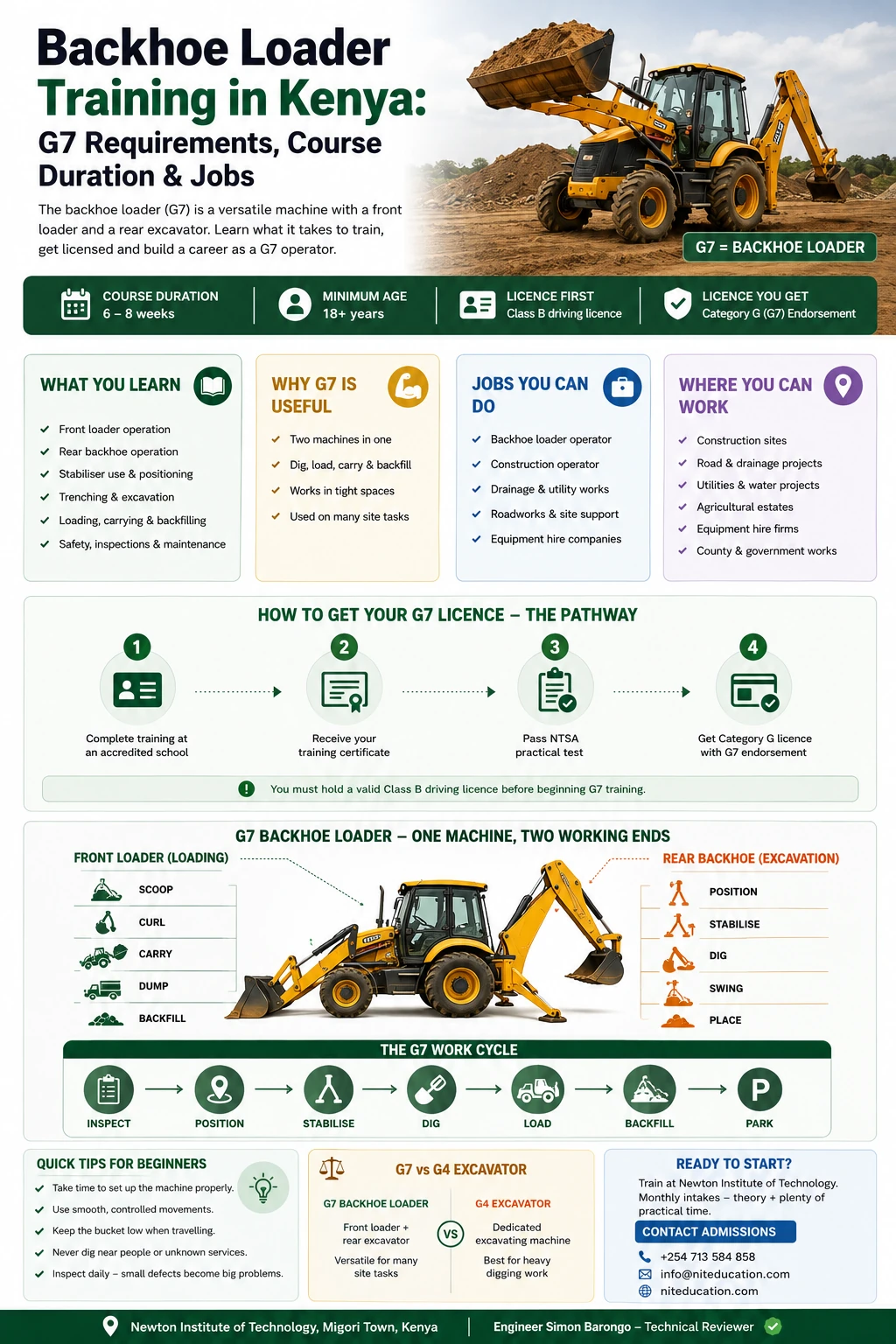
G7 backhoe loader: one machine, two working ends
The infographic gives the quick picture: requirements, training route, front-loader work, rear-backhoe work and the G7 work cycle.
Entry route
G7 backhoe loader training requirements in Kenya
The national Category G rules and NIT’s admission pathway should be read separately. Under the current national rules, an applicant must already hold a valid driving licence in another category, be at least 20 years old and have medical test certification.
Kenya’s published Category G curriculum covers industrial, construction and agricultural plant. It requires another valid driving-licence category, minimum age 20, medical certification and training through an accredited institution. NIT’s own route specifically uses Class B before Category G.
Minimum age
Category G applicants must be at least 20 years old under the published curriculum.
Class B first
NIT advises learners to complete a valid Class B licence before beginning the plant-operator route.
Medical certification
Medical test certification forms part of the national Category G eligibility requirements.
Confirm G7 availability
If backhoe loader is your priority, confirm that G7 is available for your intended intake before payment.
Training and endorsement route
How the NIT G7 pathway fits together
- Complete Class B
Start with a valid Class B driving licence for the NIT route.
- Select G7
Follow the applicable PDL/machine-selection process for the backhoe loader.
- Train practically
Build supervised skill on the front loader, rear backhoe, positioning and safety.
- Assessment
Complete the applicable test and competence requirements.
- Endorsement
Proceed through the approved Category G endorsement process.
For the full licensing explanation and the broader G1–G12 structure, use NIT’s NTSA Category G Plant Operator Licence in Kenya guide.
Course duration
How long does backhoe loader training take?
Training duration differs between institutions. At NIT, the current plant-operator programme takes two months, combining theory with supervised practical work.
For G7, duration alone is not enough. A learner needs enough actual machine time to become familiar with front-loader work, rear excavation, stabiliser setup, repositioning and safe shutdown.
NIT’s current plant-operator training balance is approximately 70% practical and 30% theory.
How much supervised time will I personally spend operating the backhoe loader? For G7, meaningful machine time matters more than a long list of machine names on a brochure.
Core G7 skill
One machine, two working systems
Load, carry and backfill
- Approach loose material under control.
- Fill and curl the bucket without unnecessary aggression.
- Travel with the bucket in a sensible position.
- Dump accurately where the task requires.
- Use the front end for material movement and backfilling where appropriate.
Position, stabilise and excavate
- Set the machine up before digging begins.
- Coordinate boom, dipper or stick and bucket.
- Control swing movement and spoil placement.
- Watch the whole work area—not only the bucket.
- Know when repositioning is safer than stretching the machine.
Machine setup
Why stabiliser setup matters before rear excavation
Rear excavation starts before the bucket enters the ground. The operator first chooses a suitable position, checks the ground and then deploys the stabilisers according to the machine, site conditions and manufacturer’s procedure.
Stabilisers help create a suitable working platform, but they do not make every position safe. Soft ground, slopes, excavation edges and restricted working space still require judgement.
Choose the working point
Allow enough room for the rear attachment, spoil placement and safe machine movement.
Read the surface
Look for soft ground, slope, excavation edges and other conditions that could affect stability.
Control the work area
Keep track of ground personnel, vehicles, structures and blind spots around the machine.
Start only after setup
The digging cycle makes sense only after positioning and stabilisation have been checked.
From the training yard
What beginners usually find difficult on G7
New trainees can become so focused on watching the rear bucket that they forget the rest of the machine. Another common difficulty is changing from front-loader work to rear excavation and expecting both ends to behave like one control system. Good supervision keeps bringing the learner back to positioning, surroundings and the job—not only the attachment.
What practical training should correct
- Jerky joystick or lever movements.
- Carrying the front bucket unnecessarily high.
- Starting excavation before proper setup.
- Poor spoil placement.
Where awareness matters
- Ignoring blind spots while watching the bucket.
- Stretching for a poor working position instead of repositioning.
- Ignoring unusual machine behaviour or visible defects.
- Forgetting underground or overhead hazards.
Practical assessment
G7 practical readiness check
A new learner does not need to look like an operator with ten years of experience. But the basic actions should be deliberate, repeatable and safe.
| Practical task | What a work-ready beginner should demonstrate | Why it matters |
|---|---|---|
| Walk-around | Notices obvious defects and unsafe conditions. | Prevents avoidable machine and site risk. |
| Positioning | Selects a workable setup for the intended task. | Good digging begins with good setup. |
| Stabilising | Sets the machine correctly for rear excavation. | Supports a controlled working platform. |
| Rear digging | Coordinates boom, dipper and bucket smoothly. | Accuracy and control come before speed. |
| Spoil placement | Places excavated material deliberately. | Keeps access and the next work stage in mind. |
| Front-loader work | Loads, carries and dumps under control. | Shows competence on the machine’s second working end. |
| Repositioning | Secures the machine before moving. | Reduces risk during the transition between tasks. |
| Shutdown | Parks and leaves the machine safely. | The work cycle is not complete until the machine is secure. |
Work applications
What jobs can a G7 backhoe loader operator do?
Look for the work the machine performs, not only adverts that use the exact phrase “G7 operator.” Relevant roles can appear as backhoe loader operator, backhoe operator, plant operator, earthmoving equipment operator or multi-skilled plant operator.
Trenching and backfilling
Drainage and smaller civil works can use both excavation and loader functions.
Maintenance support
Backhoes can support drainage, small excavations and material movement.
Water, sewer and services
Authorised trenching requires close coordination with supervisors and ground personnel.
General site support
Shallow excavation, loading, spoil movement and backfilling can all appear on smaller sites.
For the broader employment pathway, employer expectations and first-job strategy, read Plant Operator Jobs in Kenya.
Machine comparison
G7 backhoe loader vs G4 excavator
| Decision point | G7 Backhoe Loader | G4 Excavator |
|---|---|---|
| Working system | Front loader + rear excavating unit. | Dedicated excavating machine. |
| Best fit | Mixed loading, trenching and backfilling work. | More specialised excavation and material handling. |
| Learning focus | Two operating ends plus stabiliser setup and repositioning. | Deeper focus on excavator controls and working radius. |
| Typical decision | Choose when versatility across smaller site tasks matters. | Choose when dedicated excavation is the main interest. |
Neither machine is automatically better. Choose according to the work you want to learn. For the dedicated G4 guide, see Excavator Operator Training in Kenya.
Machine combinations
Should you include G7 in a multi-machine package?
Loading + excavation exposure
- G7 combines two useful operating functions.
- It suits mixed construction and drainage work.
- It can complement dedicated excavator, grader or roller skills.
Do not sacrifice practical time
- More machine codes are not automatically better.
- Confirm the actual machines available for your intake.
- Keep enough supervised time on each selected machine.
At NIT, plant-operator packages are based on selections of four, five or six machines, subject to intake availability. For current package pricing, use the dedicated Plant Operator Course Fees in Kenya guide.
Frequently asked questions
G7 backhoe loader training FAQs
What is G7 in plant-operator training?
In the Category G machine-code structure used in NIT’s plant-operator resources, G7 refers to the backhoe loader.
What are the national requirements for Category G training?
Kenya’s published Category G curriculum requires another valid driving-licence category, minimum age 20 and medical test certification.
Do I need Class B before G7 at NIT?
Yes. The NIT plant-operator pathway uses a valid Class B licence before progressing into Category G training.
Is a KCSE grade required?
The national Category G rules do not prescribe a specific KCSE mean grade.
How long does backhoe loader training take at NIT?
NIT’s current plant-operator programme runs for two months.
Is a backhoe loader the same as an excavator?
No. A backhoe loader combines a front loader and rear excavating attachment. A conventional excavator is a more specialised excavation machine.
What work can a backhoe loader do?
Typical tasks include trenching, shallow excavation, loading loose material, moving spoil, backfilling, drainage work and general construction support.
Does G7 guarantee a job?
No. Employment also depends on practical competence, experience, correct licensing, project demand and employer requirements.
Should I choose G7 or G4?
G7 suits mixed loader and excavation work. G4 has a stronger dedicated-excavation focus.
Final advice
Learn the whole G7 work cycle—not only the controls
The backhoe loader makes sense when you see the whole job: inspect the machine, read the site, position correctly, stabilise before rear excavation, dig under control, reposition safely, use the loader when the task requires it, then park and shut down properly.
Inspect → Position → Stabilise → Dig → Reposition → Load → Backfill → Park.
Newton Institute of Technology
Interested in G7 backhoe loader training?
Confirm the next intake, current G7 availability, machine combinations, timetable, package fee and the Class B-to-Category G pathway before enrolling.
Institutional / Technical review: Engineer Simon Barongo
Official source: Kenya Law — Category G curriculum and eligibility rules.
Editorial scope: This page owns G7 backhoe-loader training intent. Broad licensing, fees, jobs, syllabus and machine-marketability topics remain with their dedicated NIT resources.