

NIT Driving Guide Kenya · 2026
NTSA Driving School Curriculum in Kenya 2026
What you learn · training hours · practical progression
A practical guide to the official driving-school curriculum: common units, Model Town, yard practice, public-road training, attendance and internal assessment.
What is taught in driving school in Kenya?
Kenya’s curriculum starts with road knowledge, Model Town and human factors, then moves into the relevant vehicle class, its controls, yard manoeuvres, supervised road driving and assessment. NTSA’s mandate includes overseeing driver training and formulating or reviewing driving-school curricula.[1]
Start with the sequence
How the official driving curriculum is structured
The Traffic (Driving Schools, Driving Instructors and Driving Licences) Rules set the training framework used by licensed driving schools. The normal sequence starts with introduction to driving, fundamental driving rules, Model Town and human factors before moving into vehicle-specific knowledge, controls, yard manoeuvres and road driving.[2]
The sequence is designed so that the learner understands the rule before being expected to apply it while controlling a vehicle.
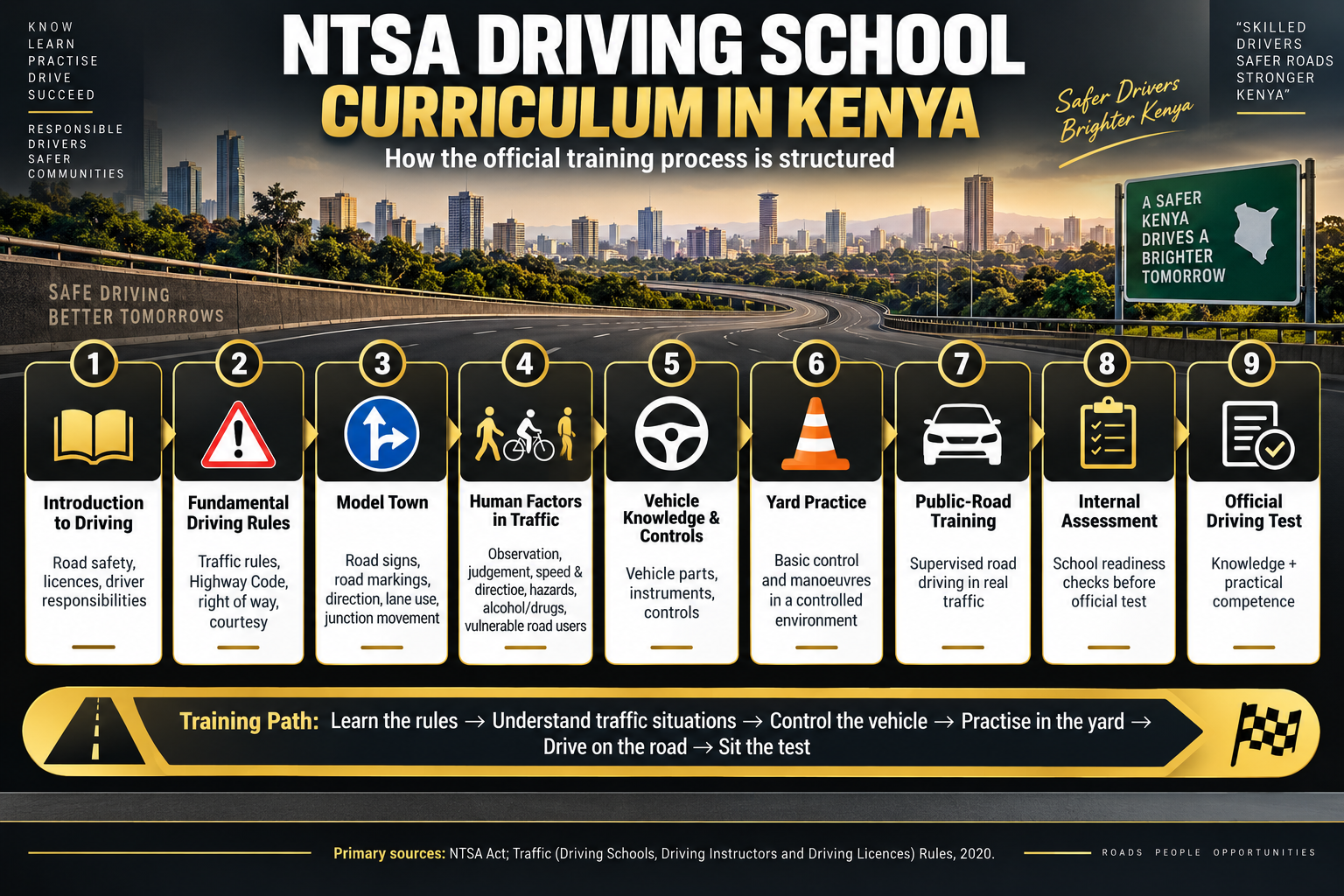
Infographic 1: The driver-training path. This visual is deliberately outside the padded article body so it renders at the wider v6 article width.
The shared foundation
The four common curriculum units
The common curriculum gives every learner a road-safety and decision-making foundation before the training becomes specific to a vehicle category.[2]
| Unit | Theory | Practical | Total |
|---|---|---|---|
| Introduction to driving | 5 hours | — | 5 hours |
| Fundamental driving rules | 4 hours | — | 4 hours |
| Model Town | 1 hour | 4 hours | 5 hours |
| Human factors in traffic | 6 hours | 2 hours | 8 hours |
| Common core total | 16 hours | 6 hours | 22 hours |
Source: Fourth Schedule to the Traffic (Driving Schools, Driving Instructors and Driving Licences) Rules.[2]
Stage 1
Introduction to driving
The first unit covers the context a new learner needs before vehicle control becomes the main focus: road safety, common causes of crashes, driver training, licences and tests, driver responsibilities, legal requirements and vehicle classes.[2]
The published allocation is 5 theory hours.
Stage 2
Fundamental driving rules
This unit deals with traffic rules, the Highway Code, road behaviour, courtesy, responsibility, right of way, vulnerable road users and appropriate action around crashes and emergencies.[2]
The published allocation is 4 theory hours.
Stage 3
Model Town
Model Town forms part of the statutory common curriculum. Learners study directional arrows, signs, markings and correct movement through different road situations. The allocation is 1 theory hour + 4 practical hours.[2]
The useful goal is not memorising one model route. It is understanding why a route is lawful or unsafe. For detailed revision, use NIT’s NTSA Driving Theory Test in Kenya guide.[4]
Stage 4
Human factors in traffic
Vehicle control is only one part of safe driving. The human-factors unit covers observation, perception, speed and distance judgement, stopping distance, speed choice, alcohol and drugs, vulnerable road users, health, safety and crash handling.[2]
The allocation is 6 theory hours + 2 practical hours.
A worked example
What changes when training becomes vehicle-specific?
After the common units, the curriculum moves into the vehicle class being studied. Category B is a useful example because many first-time car learners encounter it.
| Category B area | Main focus | Why it matters |
|---|---|---|
| Light-vehicle knowledge | Vehicle characteristics, licensing and safety knowledge. | Understand the vehicle before controlling it. |
| Construction & controls | Systems, instruments and operating controls. | Know what each control does and when to use it. |
| Basic control | Starting, stopping, steering, braking and manoeuvres. | Build consistent physical control in a managed setting. |
| Road driving | Speed, positioning, lanes, junctions, overtaking and traffic interaction. | Apply knowledge and vehicle control in real traffic. |
The published Category B-specific allocation is 12 theory hours + 34.5 practical hours = 46.5 hours. NIT’s dedicated Class B Driving Course in Kenya guide carries the detailed B1/B2 learner journey.[3]
The regulations list the 22-hour common curriculum separately from the 46.5-hour Category B-specific module. This article does not turn their arithmetic sum into a separately published official total.
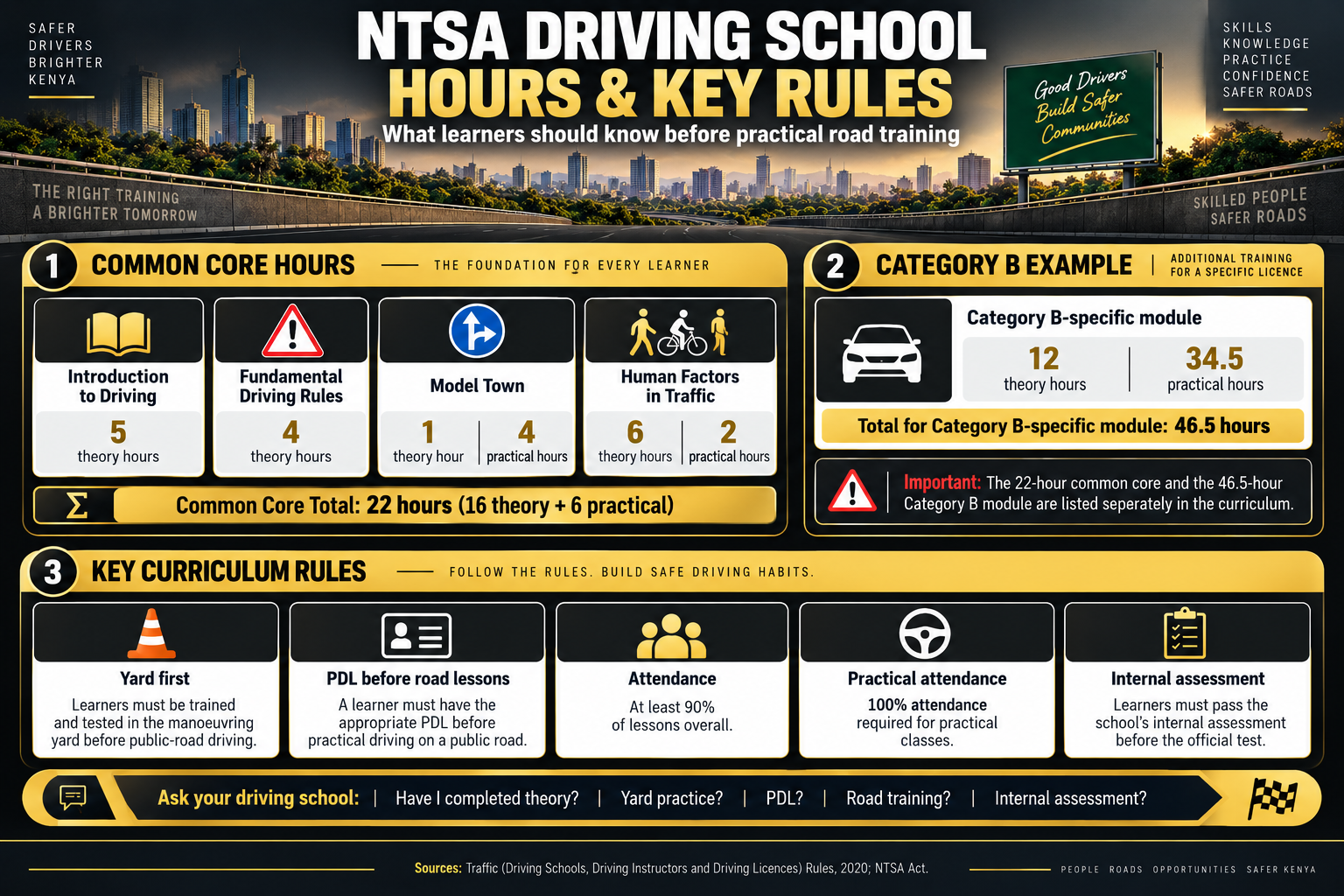
Infographic 2: Published training allocations and the curriculum rules learners should know.
Practical progression
Yard training comes before public-road driving
The curriculum requires a learner to be trained and tested in a manoeuvring yard before progressing to a public road. It also requires the learner to cover the first curriculum units and at least four hours of practical manoeuvring-yard training before the relevant PDL stage.[2]
The yard comes first. It gives the instructor a controlled setting to check whether you can start, stop, steer and position the vehicle before normal traffic is added.
Before road lessons
The PDL is required for practical lessons on a public road
The driving-school rules require the school to ensure that the learner has the appropriate Provisional Driving Licence before practical lessons take place on a public road.[2]
For the application, charge, validity and learner-driving conditions, use NIT’s dedicated PDL Kenya guide.[5]
Completion rules
Attendance is part of the curriculum
The rules say a learner is generally deemed to have fulfilled the curriculum after attending at least 90% of the lessons. Practical lessons are stricter: a learner must attend 100% of practical classes to be deemed to have completed the driving lessons.[2]
Three different roles
Curriculum vs Learner Driver Handbook vs driving test
| Item | What it does | Best way to think about it |
|---|---|---|
| Curriculum | Sets what is taught, sequence, time allocations, practical progression and assessment. | What and how training is delivered. |
| Learner Driver Handbook | Acts as the main reference material used during training. | The reference used to learn. |
| Driving test | Checks whether the learner has developed the required knowledge and practical competence. | The assessment of competence. |
The rules specifically identify the Kenya Learner Driver Handbook as the main reference material for training.[2]
Before the official test
Internal assessment comes first
A driving school is required to assess its learner before presenting that learner for the official examination. The rules provide that only learners who have achieved at least a 70% aggregate in the internal test should be presented for the official driving test, and the practical internal assessment includes a yard test followed by an on-road test.[2]
By this stage, the learner should be able to understand the rules, identify hazards, control the vehicle, complete required manoeuvres and make safe decisions without constant prompting.
Being able to move the vehicle is only one milestone. Observation, road position and junction judgement are what turn basic control into safer road driving.
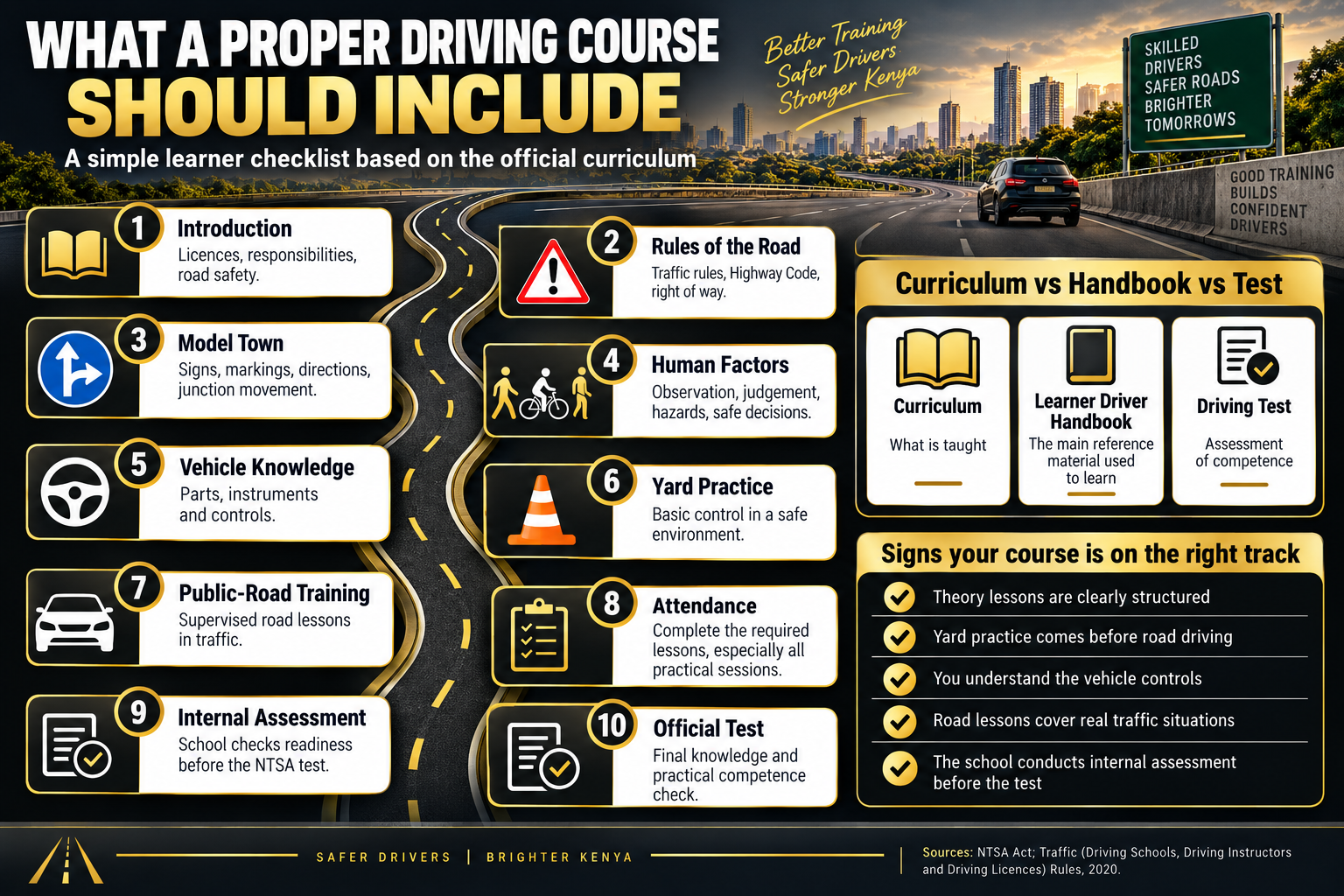
Infographic 3: A learner checklist for checking whether a driving course follows the expected curriculum progression.
Road knowledge in context
Where road signs fit into the curriculum
Road signs are not a standalone driving skill. They connect fundamental driving rules, Model Town and real road decisions. A useful learning sequence is: recognise the sign → understand the instruction → take the correct action. For detailed meanings and markings, use NIT’s Kenya Road Signs and Markings guide.[6]
A practical learner check
How to check whether your course is following the curriculum
Instead of asking only how quickly the course can finish, check whether the required stages are actually happening.
- Have you received structured theory instruction?
- Have you covered Model Town and human factors?
- Do you understand the controls of the vehicle you are training in?
- Have you completed the required yard practice?
- Do you have the appropriate PDL before public-road practical lessons?
- Are you attending every practical class?
- Will the school conduct internal assessment before the official test?
A short course is not automatically poor, and a long course is not automatically good. The stronger question is whether the prescribed instruction, practice and assessment actually take place.
Do not use one number for every class
How many hours is driving school in Kenya?
There is no responsible single hour figure that should be applied to every licence category. The regulations publish time allocations by common units and by vehicle-specific modules.[2]
Quick questions
Driving school curriculum FAQs
What is the NTSA driving school curriculum in Kenya?
It is the official framework for driver training, covering common road knowledge and human factors before progressing to vehicle-specific controls, manoeuvres and road driving.[2]
How many hours are in the common curriculum?
The published common-core allocation is 22 hours: 16 theory and 6 practical.[2]
How many hours are in the Category B-specific module?
The Category B-specific allocation is 46.5 hours: 12 theory and 34.5 practical.[2]
Must yard training come before public-road driving?
Yes. The curriculum requires training and testing in a manoeuvring yard before the learner progresses to public-road driving.[2]
Do I need a PDL before public-road lessons?
Yes. The school must ensure the learner has the appropriate PDL before practical lessons are undertaken on a public road.[2]
Can I miss practical lessons?
The rules require 100% attendance at practical classes for the learner to be deemed to have completed the driving lessons.[2]
Does the driving school test me before NTSA?
Yes. Internal assessment comes before presentation for the official test; the rules specify at least a 70% aggregate internal score for presentation.[2]
Ready to start?
Register for driving training at Newton Institute of Technology
Start with structured theory and practical training rather than preparing only for the examination. Tell Admissions which licence category you intend to pursue so you can be guided to the appropriate training pathway.