

Global operator standards ISO 7130 guide
Global Heavy Equipment Operator Training Standards
ISO 7130 · Cross-Border Worksite Readiness
A practical guide to the standards behind earth-moving operator training, machine controls and worksite safety—and what still has to be checked when an operator crosses borders.
Training standards → worksite competence
What do international operator training standards actually do?
They create recognised technical reference points for training, controls, machine safety and worksite systems. They can make an operator’s competence easier to transfer between machines and projects, but they do not create one worldwide heavy-equipment operating licence.
Heavy machinery moves between countries far more easily than operator qualifications do.
An excavator can be shipped from one project to another, sold into a different market or transferred between contractors while remaining fundamentally the same machine. For the person in the cab, the transition is more complicated. Control arrangements can differ. Site procedures change. Employers have their own competency requirements, and the legal authority to operate equipment in one country may not automatically be recognised somewhere else.
International standards help create some consistency. They give manufacturers, trainers and employers recognised reference points for operator training, machine controls, safety and workplace systems. For operators, they provide a useful way of understanding which parts of professional competence can travel with them and which parts must be checked again when the worksite changes.
One standard is particularly important when discussing earth-moving machinery training: ISO 7130:2013 — Earth-moving machinery — Operator training — Content and methods.
ISO 7130 provides a basis for the content and methods used to train operators of earth-moving machinery. It also establishes criteria for evaluating operator competence, although it does not prescribe a universal proficiency test and does not replace national or regional training requirements.
That distinction sits at the heart of this guide. Internationally relevant training can help an operator build skills that transfer between worksites. It does not create one worldwide operating licence.
ISO 7130 applies specifically to earth-moving machinery as defined through the ISO 6165 classification framework. “Heavy equipment” is a broader category. Other machine families can have their own operator-training standards. Rough-terrain trucks, for example, are covered separately by ISO 23676:2020.
Training standard
1. ISO 7130 and what internationally structured operator training actually means
ISO 7130 is useful because it brings the discussion back to what an operator genuinely needs to learn. The standard is not an international operator licence. It is a framework for training.
ISO states that the standard provides the basis for developing earth-moving machinery operators who understand the manufacturer’s instructions for safe and proper operation and routine maintenance. It also establishes criteria that can be used when evaluating the competence of a person operating and carrying out routine maintenance on earth-moving equipment.
A competent learner needs to understand the machine being operated, what the manufacturer expects, how the controls respond, where the machine’s limitations lie and what normal operator-level care involves. This becomes especially important once a trainee leaves the familiarity of a training yard.
Does ISO 7130 specify one training duration?
No single duration applies to every trainee or every machine. The training needed depends on factors such as the machine family, the work it will perform, machine and attachment complexity, and the knowledge and experience the learner already has.
Someone approaching an excavator for the first time does not start from the same point as an experienced equipment operator converting to another earth-moving machine. Training quality therefore cannot be judged only by counting calendar days. The better question is whether the learner has received enough appropriate instruction and supervised practice to operate competently.
For the actual subjects covered in NIT’s programme, see the Plant Operator Course Syllabus in Kenya. This guide focuses on the international standards framework behind operator preparation.
One system, different roles
2. How the main earth-moving machinery standards fit together
| Standard | Main role |
|---|---|
| ISO 7130 | Operator training content and methods |
| ISO 6165 | Identification and classification of earth-moving machinery |
| ISO 6405-1 | Common symbols used on earth-moving machinery controls and displays |
| ISO 6405-2 | Symbols for specific machines, equipment and accessories |
| ISO 10968 | Operator-control requirements and guidance |
| ISO 20474 series | Earth-moving machinery safety requirements |
| ISO 45001 | Wider occupational health and safety management framework |
ISO 6165:2022 provides the vocabulary and identification structure used to classify earth-moving machinery according to function and design. The ISO 6405 standards deal with symbols an operator sees on controls and displays. ISO 10968 addresses the controls themselves, while the ISO 20474 series deals with machinery safety. ISO 45001 sits at the wider worksite-management level.
Seen together, the picture becomes clearer: international operator competence is not built around one standard. Training, machine identification, controls, safety and site management all interact.
Infographic 1 · Standards map
How earth-moving operator standards fit together
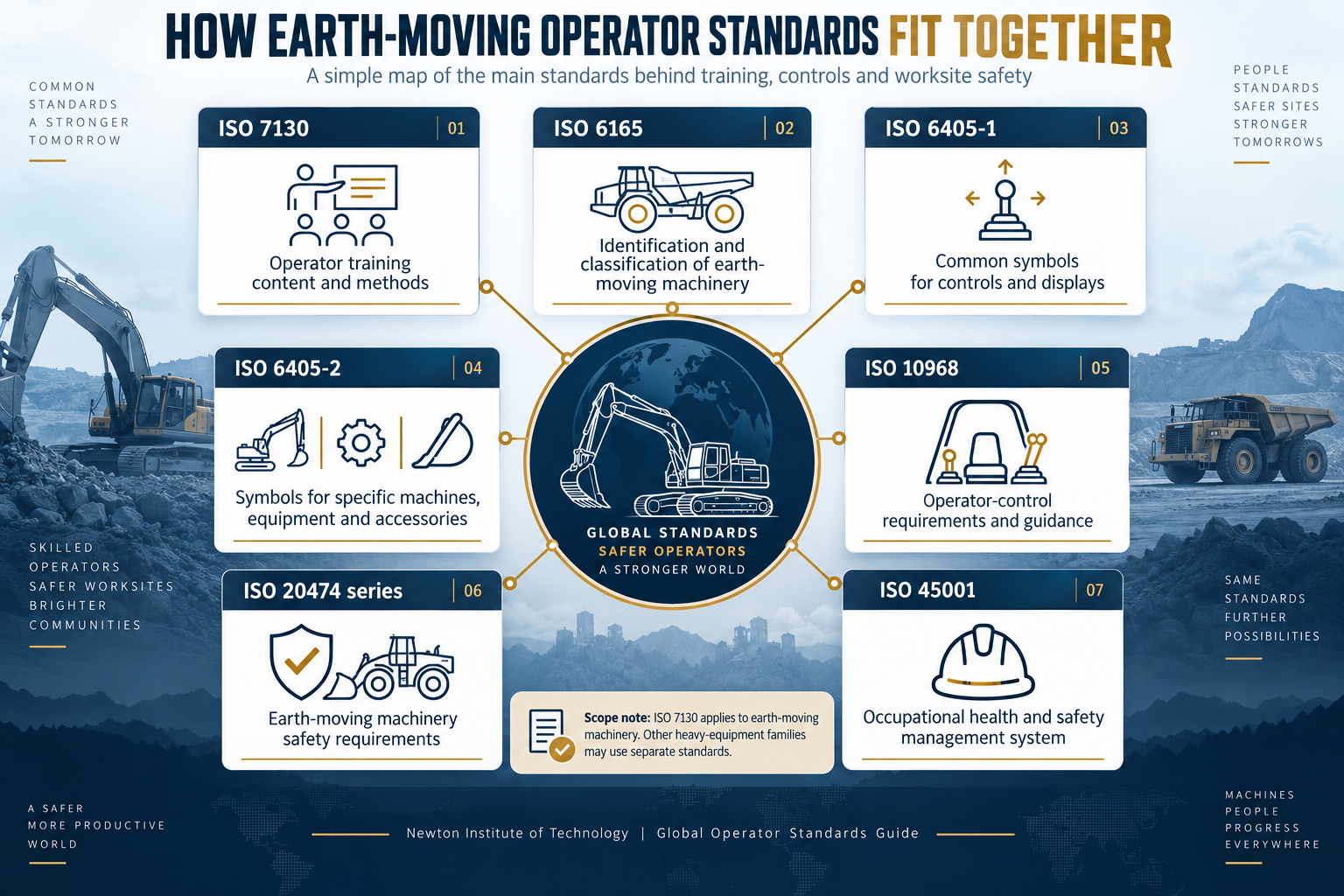
Infographic — How Earth-Moving Operator Standards Fit Together. Newton Institute of Technology.
Inside the cab
3. From training standards to the controls inside the cab
The real test of operator training eventually happens in the seat. A learner can understand a control diagram perfectly in class and still need time to develop the coordination required to use the machine smoothly.
Hydraulic equipment reacts to small movements. Machine position affects stability. Ground conditions influence traction and balance. Several functions may need to be coordinated at once. Practical training is where those ideas become judgement.
ISO 10968 and operator controls
ISO 10968:2020 specifies requirements and guidance for operator controls on earth-moving machinery within its scope. It contributes to common control principles, but it does not require every manufacturer to build exactly the same cab.
Operators may still encounter variations in hydraulic response, electronic settings, joystick functions, braking, steering, attachment controls and display systems. Standardisation improves familiarity. It does not remove the need to check the machine.
ISO and SAE excavator controls
SAE J1177 deals specifically with the arrangement and direction of movement for primary controls on mobile hydraulic excavators. SAE J1814 provides broader guidance for operator controls on off-road machines.
Identify the controls. Confirm the configuration. Familiarise yourself with the machine’s response. Then work. An unfamiliar cab should make an experienced operator more observant, not more willing to guess.
Machine + worksite
4. Machine safety and the worksite around the operator
The ISO 20474 series addresses safety requirements for earth-moving machinery. ISO 20474-1:2017 provides general requirements that apply across more than one earth-moving machine family and is used alongside machine-specific parts of the series.
Those standards deal with the machinery side of safety. The operator has another responsibility: noticing what is happening around the machine. Ground can deteriorate during a shift. A person can enter a blind area. A trench edge may no longer be safe. Another machine can move unexpectedly.
Detailed site-safety procedures belong in NIT’s Plant Operator Safety Rules in Kenya, while the actual inspection procedure belongs in the Plant Operator Pre-Start Inspection Checklist.
The wider safety system
ISO 45001:2018 provides an international framework for occupational health and safety management. An equipment operator may experience that framework through formal inductions, traffic routes, toolbox talks, restricted areas, equipment records, emergency procedures and defined systems for reporting defects or incidents.
A machine operator does not need to memorise ISO 45001 to function professionally. They do need to understand that on a structured worksite, safety is a system rather than an individual preference.
Do not confuse the terms
5. A training certificate, operating licence and competence are different things
A training programme develops knowledge and practical skill. A certificate provides evidence that particular training or assessment took place. A licence or endorsement, where required, provides legal or regulatory authority under the rules of that jurisdiction.
An employer assessment determines whether the company is satisfied that the individual can operate particular equipment safely. Site authorisation may then determine whether that operator is permitted to work independently on a particular project.
ISO 7130 makes clear that its training framework is not intended to replace national or regional requirements. The same broad principle appears in standards for other machine families, including ISO 23676 for rough-terrain truck operator training.
Skills may travel well. Legal recognition has to be checked.
Cross-border reality
6. What travels with an operator — and what needs checking again?
| Experience that can remain valuable | What should be verified at the new worksite |
|---|---|
| Machine-handling experience | Legal licence or endorsement requirements |
| Hazard awareness | Local occupational safety rules |
| Inspection discipline | Employer inspection and reporting procedures |
| Understanding of machine-control principles | The actual machine’s control configuration |
| Routine maintenance awareness | Site-specific maintenance responsibilities |
| Training certificates and work records | Recognition or acceptance by the employer or regulator |
| Communication discipline | Local signals, radio procedures and site terminology |
| Previous machine experience | Employer practical-assessment requirements |
The underlying competence can travel while the exact procedure changes. A competent operator may know how to inspect an excavator well, while a new employer still uses a different checklist, defect-reporting system or authorisation process.
Infographic 2 · Transfer vs verify
What usually travels well — and what must be verified again
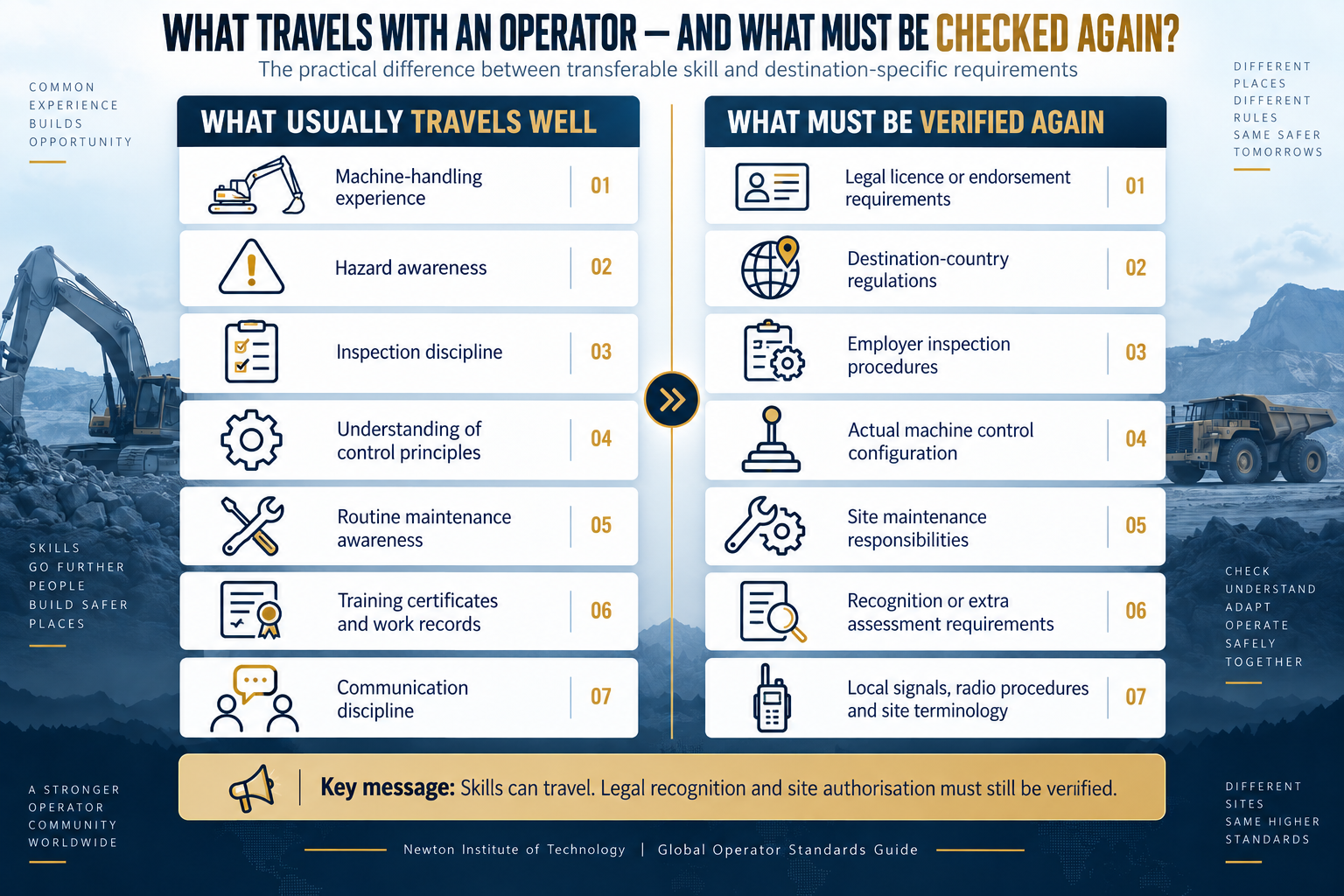
Infographic — What Travels With an Operator and What Must Be Checked Again? Newton Institute of Technology.
Recognition is local
7. Can a plant operator qualification be used in another country?
It can be useful evidence of training and previous competence, but operators should not assume that it automatically provides legal authority abroad. Requirements can vary according to the destination, equipment category, regulator, employer and type of project.
A simple way of approaching international work is to begin with the actual job: Which country? Which machine? Which authority regulates it? What does the employer require?
For Kenyan operators, the NTSA Category G Plant Operator Licence in Kenya guide explains the domestic licensing pathway. Destination-by-destination certification questions should be checked against the applicable regional or national authority before travel or employment decisions are made.
Competence that lasts
8. The skills that continue to matter when the country changes
Rules vary. Good operating habits are surprisingly consistent.
A person who has learned to inspect before starting, recognise abnormal machine behaviour, coordinate controls carefully and maintain awareness of people around the equipment carries useful habits from one project to another.
Mechanical awareness travels too. A hydraulic leak deserves attention wherever the machine is working. So does an abnormal noise, poor visibility or unstable ground.
The international operator does not need to know every regulation in every country before beginning a career. What matters is having enough technical judgement to recognise what is already familiar and enough discipline to find out what is different.
Comprehension before vocabulary
9. Why technical language matters on a new worksite
Heavy equipment operation has its own vocabulary: hydraulics, stability, ground pressure, exclusion zones, isolation, attachments, braking systems and defect reporting. A trainee can memorise those words without fully understanding the ideas behind them.
Newton Institute of Technology can support technical instruction in English, French (Français) and Swahili (Kiswahili) so that important operating concepts can be understood clearly before the learner builds the terminology required by a particular employer or worksite.
The objective is comprehension rather than translation for its own sake. Understanding why a machine can become unstable is far more useful than simply knowing the word stability.
From training yard to worksite
10. From NIT training to a professional worksite
At Newton Institute of Technology, plant operator training combines practical machine exposure with technical instruction. Learners work with controls, machine familiarisation, operating awareness, inspection principles, movement, positioning, operator-level machine care, shutdown and defect reporting.
The aim is not to make trainees believe that every machine will behave exactly like the one they learned on. The better outcome is an operator who notices the differences.
Practical experience builds the coordination required to operate a machine. Supervised workplace exposure then begins to add something equally important: judgement.
Train → develop competence → gain experience → document it → verify destination requirements → complete employer/site assessment → operate.
There may be additional steps depending on the country and machine. That is normal. The strongest preparation is not a promise that those steps will disappear. It is having the skills and documentation needed to meet them.
Infographic 3 · Operator pathway
From training yard to cross-border worksite
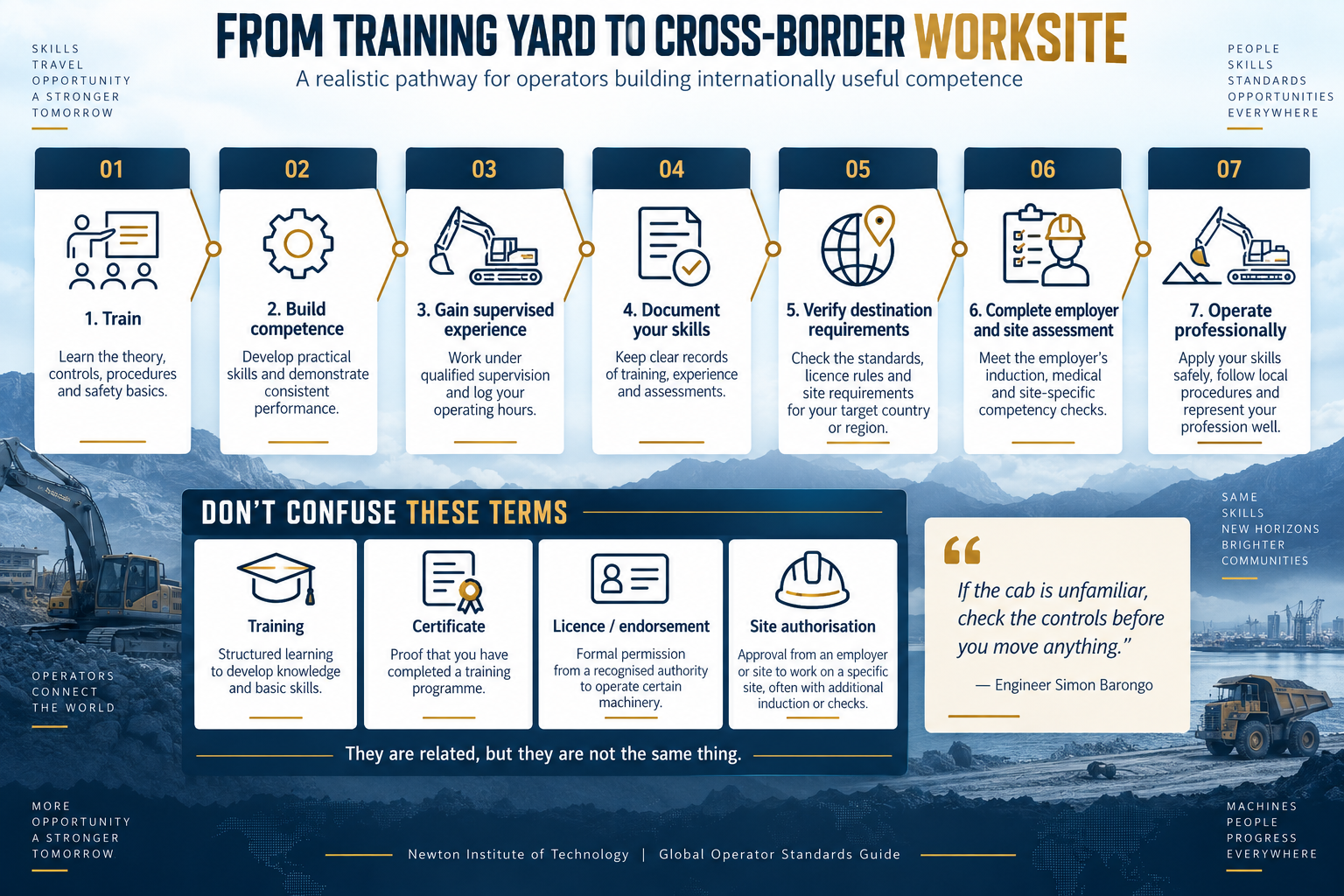
Infographic — From Training Yard to Cross-Border Worksite. Newton Institute of Technology.
Frequently asked questions
Heavy equipment operator training standards FAQs
What is ISO 7130 operator training?
ISO 7130:2013 is an international standard covering training content and methods for operators of earth-moving machinery as defined through the ISO 6165 framework. It provides a basis for developing operator knowledge and skills related to safe operation and routine maintenance.
Does ISO 7130 cover every type of heavy equipment?
No. Its scope is earth-moving machinery as defined in ISO 6165. Other equipment families can have separate standards. Rough-terrain truck operator training, for example, is addressed by ISO 23676:2020.
Does ISO certify individual heavy equipment operators?
ISO develops standards. ISO 7130 does not create a universal individual operator licence and is not intended to replace national or regional operator-training requirements.
Does ISO 7130 specify one training duration?
No single duration applies to every operator and every earth-moving machine. Training needs vary according to the machine, application, complexity and the trainee’s existing knowledge and experience.
What is the difference between ISO 7130 and ISO 10968?
ISO 7130 deals with operator training content and methods. ISO 10968 deals with operator controls on earth-moving machinery. They support different parts of the same wider competence environment.
Are ISO or SAE excavator controls identical on every machine?
No. Standards create recognised control principles, but differences in control types, locations, movement, electronic configuration and machine systems can still exist. An operator should verify an unfamiliar machine before productive operation.
Can a Kenyan plant operator qualification be used abroad?
It can provide evidence of training or experience, but the operator should verify licensing, recognition, assessment and employer requirements in the destination country before assuming that the qualification provides legal authority there.
Final takeaway
International worksite readiness is built in the cab
Standards provide structure. They help define what operator training should address, how earth-moving machinery is classified, how common symbols are presented, how controls are approached and how machine and worksite safety are managed.
But sooner or later, the operator has to sit in the machine. Do you check an unfamiliar control arrangement before moving? Do you recognise when site conditions have changed? Do you report a machine problem instead of hoping someone else notices it? Can you follow a new employer’s procedures even when they differ from the last worksite?
Build competence that travels, then verify the rules wherever the work takes you.
Explore practical training
Build professional worksite readiness at Newton Institute of Technology
Newton Institute of Technology provides practical plant operator training for learners building professional machine competence. Prospective trainees can review available plant operator pathways, machine options and admission procedures with the NIT admissions team.
Training focusPractical machine competence
Learning supportEnglish · French · Swahili
AdmissionsContinuous intake
Technical standards referenced
ISO 7130:2013 — Earth-moving machinery — Operator training — Content and methods.
ISO 6165:2022 — Earth-moving machinery — Basic types — Identification and vocabulary.
ISO 6405-1:2017 and ISO 6405-2:2017 — Symbols for operator controls and other displays.
ISO 10968:2020 — Earth-moving machinery — Operator’s controls.
ISO 20474-1:2017 — Earth-moving machinery — Safety — Part 1: General requirements.
ISO 45001:2018 — Occupational health and safety management systems.
SAE J1177_201906 — Hydraulic Excavator Operator Controls; SAE J1814_202005 — Operator Controls — Off-Road Machines.
ISO 23676:2020 — Rough-terrain trucks — Operator training — Content and methods.
Standards and regulatory requirements can change. Operators, training institutions and employers should verify the requirements applicable to the particular machine, jurisdiction and worksite.