

NIT Plant Operator Licensing Guide Kenya · 2026
NTSA Category G Plant Operator Licence
in Kenya
G1–G14 codes · requirements · PDL · test · endorsement
A decision-led guide to Category G eligibility, plant-machine codes, PDL, supervised training, assessment, Certificate of Competence and the checks to make before you pay.
Your Category G decision
How does the NTSA Category G licensing process work?
Category G covers industrial, construction and agricultural plant and equipment. The published rules require a learner to hold a valid driving licence in another category, be at least 20 and meet the medical-certification requirement. Training then leads through supervised practical work and assessment toward a Certificate of Competence and the applicable Category G authorization.
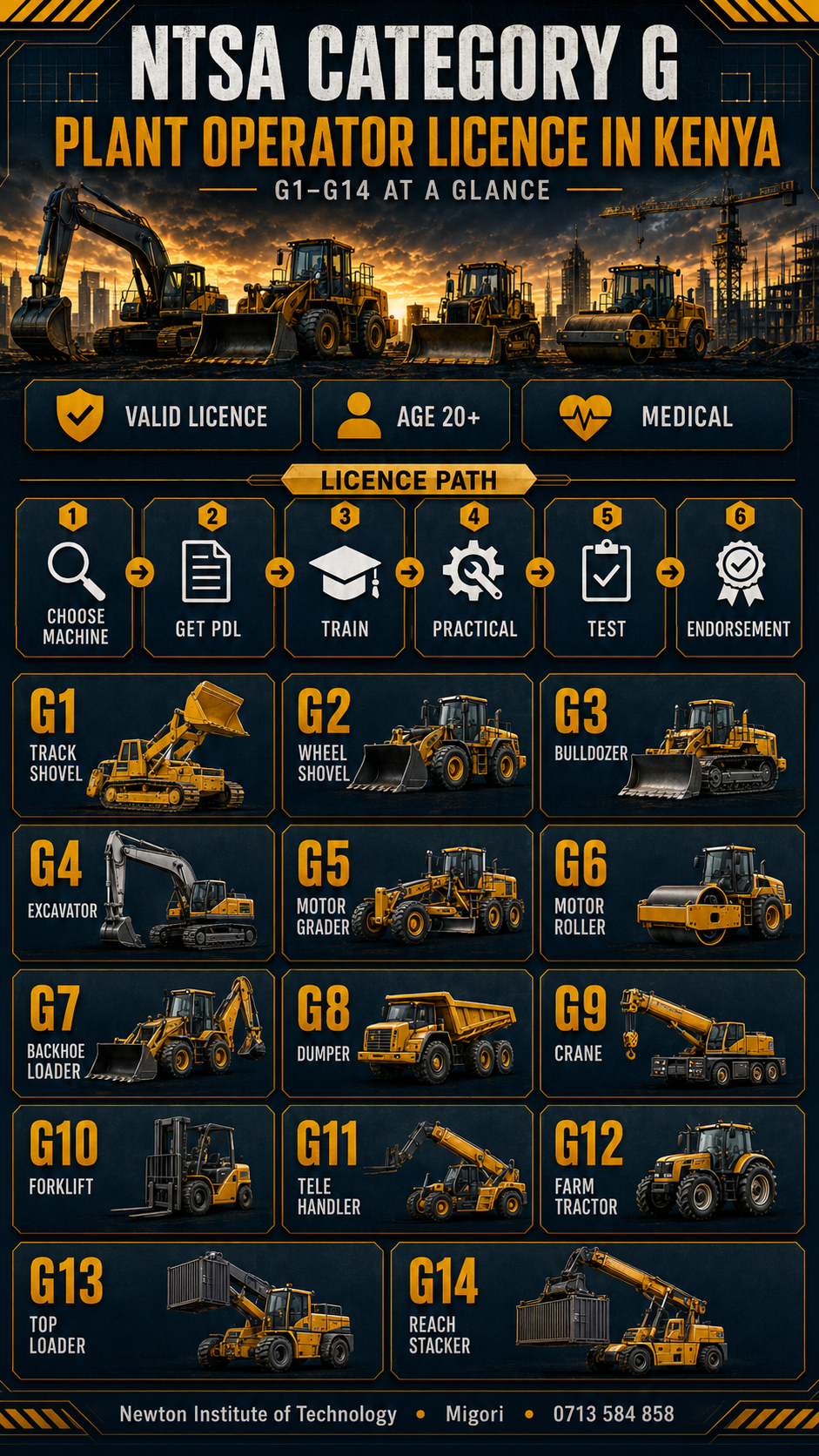
The practical sequence is: check eligibility → choose the machine → obtain the applicable PDL → train and complete supervised practical work → pass the required assessment → complete the licence endorsement process.
Visual summary
Category G at a glance
The infographic keeps the process deliberately short. Use the detailed sections below for the legal wording, document checks and decisions that need more explanation.
Trust the right source
What is official — and what still needs a live check?
Category G information comes from different places. Use the legal rules for the national requirements, NTSA/eCitizen for the live transaction, and NIT only for NIT-specific training arrangements.
National requirements
Category G coverage, minimum age 20, an existing valid licence, medical certification, supervised practical training and the Certificate of Competence requirement.
Current service workflow
Use the live portal for the PDL transaction, current application details and the amount displayed when you pay. The PDL guidance currently gives a three-month validity period.
Current G1–G14 machine categories
The confirmed NTSA Class G machine list used in this guide now runs from G1 Track Shovel to G14 Reach Stacker. Check the live portal for transaction wording and administrative changes before payment.
NIT-specific requirements
NIT’s route uses Class B before Category G and has its own current duration, machine packages, fees and intake arrangements. These are institutional facts, not universal national rules.
Legal requirement? Check the regulation. Live payment or application? Check eCitizen. NIT admission or fees? Check NIT admissions.
Primary references: Kenya Law Category G rules and NTSA/eCitizen PDL guidance.
Start before you pay
Three minimum checks before Category G training
Existing licence
You need a valid driving licence in another category under the published national rule.
Age 20+
The Category G curriculum sets twenty years as the minimum enrolment age.
Medical certification
Medical test certification is one of the published minimum entry conditions.
Machine decision
Know which plant machine you intend to train on before you move too far into the application process.
If one of the first three legal conditions is not in place, deal with it before committing money to a machine package.
A common point of confusion
Does NTSA specifically require Class B before Category G?
The published national Category G regulation does not say “Class B only”. It says the learner must hold a valid driving licence in another category.
Valid licence in another category
- This is the wording in the published Category G curriculum. It should not be silently rewritten as a universal Class B-only legal rule.
Class B before Category G
- Newton Institute of Technology requires learners following its plant-operator route to hold a valid Class B licence before progressing into Category G training and licensing.
For an NIT applicant, the practical decision is simple: if Class B is not yet in place, complete that stage first.
Machine selection
G1–G14 plant operator codes in Kenya
The confirmed current NTSA Class G machine categories run from G1 Track Shovel to G14 Reach Stacker. Use this list when choosing your training machines, then check the live NTSA/eCitizen workflow for transaction details before payment.
Track shovel
Earth handling and loading on tracked equipment.
Wheel shovel
Loading yards, stockpiles and construction sites.
Bulldozer
Clearing, pushing, spreading and rough grading.
Excavator
Excavation, trenching, drainage and loading.
Motor grader
Road construction, shaping and finish grading.
Motor roller
Compaction and road-building work.
Backhoe loader
Combined excavation and loading work.
Dumper
Controlled movement of soil, aggregate and spoil.
Crane
Lifting operations, including applicable mobile or truck configurations.
Forklift
Warehouses, factories, depots and material handling.
Tele Handler
Telescopic-boom lifting and material placement on construction and industrial sites.
Farm tractor
Agriculture, towing and compatible implements.
Top Loader
Container and heavy-load handling in terminals, yards and logistics operations.
Reach Stacker
Container handling and stacking in depots, ports and logistics yards.
The latest confirmed structure includes G11 Tele Handler, G13 Top Loader and G14 Reach Stacker.
Choose for the work you want
Which machine direction fits your goal?
The number of machines should not be your first question. Start with the kind of work you want to enter, then compare machines and training access.
Grader · roller · excavator · dumper
Relevant to road construction, shaping, compaction, drainage, excavation and haul support.
Track shovel · wheel shovel · dozer · excavator · backhoe
Strong directions for excavation, loading, clearing and general site earthworks.
Forklift · tele handler · crane · top loader · reach stacker
Focused on lifting, stacking and material or container handling in sites, yards, depots, terminals and warehouses.
Farm tractor
A direct route where your likely work is agricultural rather than construction-led.
Four machines with meaningful supervised operating time can be a stronger training decision than six machines you barely touch.
For a job-market comparison, use NIT’s Most Marketable Plant Operator Machines in Kenya guide.
Learner licence
When to apply for the PDL
PDL means Provisional Driving Licence. NTSA’s current eCitizen guidance says the applicant should enrol in a licensed driving school and apply online. The PDL is normally valid for three months and can be renewed for further three-month periods after payment of the prescribed fee.
Its validity period matters. Align the PDL with your confirmed school, machine choice, practical schedule and test preparation.
Timing matters. If you obtain it too early and then delay training, part of that validity period disappears before you have gained useful practical time.
Before submitting
Check the application once
A small error is easier to fix before test booking than after it.
- Your existing driving licence is valid.
- Your name and identification details are correct.
- The intended training category is correct.
- The machine details match what you intend to train on.
- You understand which payments go to government and which go to the institution.
Keep the record consistent
The documents should tell the same story
| Stage | What to check | Why it matters |
|---|---|---|
| Before enrolment | Existing licence, age and medical requirement | Confirms basic eligibility before you commit money. |
| PDL | Personal details and applicable category/machine | An early mismatch can follow the process forward. |
| Training record | Machine actually trained | Your practical record should correspond with the intended test. |
| Test booking | Correct category/machine details | Check before the assessment date arrives. |
| After passing | Certificate of Competence details | This is a key licensing record. |
| Final licence | Correct Category G authorization | Confirm the final record reflects the approved process. |
Keep official receipts and important application records until the process is complete.
More than the controls
What Category G training is supposed to cover
The official curriculum is broader than learning how to start a machine and move the controls. It covers introduction to plant machinery, basic controls, legal aspects, practical operation and examination.
Inspect
Daily or pre-shift inspection comes before operating the machine.
Control
Learn the machine’s controls, movement, positioning and working function.
Operate safely
Varying terrain, obstacles, routes, attachments and lifting procedures matter where applicable.
Shut down & report
Safe shutdown and the operator’s daily servicing responsibilities are part of competent operation.
A useful test when comparing schools is simple: does the programme teach you how to operate the machine, or merely how to move it?
The part many guides miss
The official curriculum includes supervised workplace operation
Plant operation cannot be learned properly from classroom notes alone. This supervised practical component is one reason to ask a school exactly how real operating exposure is handled.
From training to competence
The Category G assessment path
- Confirm eligibility
Licence, age and medical conditions first.
- PDL & machine
Make sure the learner record reflects the intended training route.
- Train & practise
Complete instruction and supervised practical plant operation.
- Internal + NTSA test
Demonstrate theory, safe judgement and practical competence.
- Competence & endorsement
Follow through on the Certificate of Competence and licence process.
The Category G curriculum provides for theory and practical examination. The published examination schedule states an overall pass requirement of above 70%.
Before assessment, you should be comfortable with inspection, controls, safe starting, movement, positioning, the working task, communication and shutdown. Reaching the final week of a timetable does not automatically make a learner test-ready.
If the first attempt does not go well
Use a failed assessment to identify the real weakness
Was the problem control coordination, inspection, positioning, theory, safety judgement or simply too little machine time? Fix that issue before another attempt.
The current Category G curriculum states that a trainee who fails the final examination may make another attempt after two months. That period is more useful when it is spent correcting the actual weakness rather than only waiting for the calendar to move.
Know which document you have
Training certificate, Certificate of Competence and Category G endorsement
| Document | What it shows | Decision point |
|---|---|---|
| College training certificate | You completed the institution’s training programme. | It is not automatically the final driving-licence authorization. |
| Certificate of Competence | You passed the required driving examination for licensing purposes. | This is a key step after assessment. |
| Category G endorsement | The applicable professional authorization is reflected on the driving licence. | Check the final record after completing the licence process. |
When somebody says “I have my plant operator certificate”, ask which document they mean. That one question prevents a lot of confusion.
Government charges
Published PDL and driving-test fees
Training fees and government transactions are separate. Use the published statutory figures for planning, then use the live eCitizen amount when you actually pay.
Portal totals can include other applicable charges. Keep the official receipt, and do not treat an old screenshot or a bundled school figure as the current government fee schedule.
Entry question
Is there a KCSE mean-grade requirement for Category G?
The published minimum Category G enrolment conditions do not specify a KCSE mean grade. They focus on the existing valid driving licence, minimum age and medical certification.
A training institution can still have its own admission procedures. The important distinction is not to turn an institutional entry condition into an NTSA national KCSE requirement unless the official rule actually says so.
Later progression
Adding another plant machine later
One machine does not make you competent on every other plant machine. Excavator, grader, forklift and crane controls and hazards differ substantially.
Before paying for another machine, establish three things: what additional training is required, whether a fresh PDL or test step applies, and what licence or endorsement transaction is current at that time. Administrative procedures can change, so verify the live process when you are ready to add the machine.
Before you pay a school
Eight questions worth asking
A serious training provider should be able to explain the training and licensing route without hiding everything behind “we will organise it”.
- Which machines will I personally operate during this intake?
- How much supervised practical time will I receive on each machine?
- Are those machines physically available now?
- What exactly is included in the school fee?
- Which payments are made separately through eCitizen?
- How is the internal assessment done?
- How is supervised practical exposure handled?
- How does the NTSA testing and final licence process fit into the programme?
Decision map
Your next step depends on where you are now
| Where you are | Best next action | Supporting NIT guide |
|---|---|---|
| I do not have NIT’s Class B foundation | Complete Class B first if you plan to follow the NIT route. | Driving / admissions guidance |
| I qualify but have not chosen machines | Compare machines against the work you want. | Most Marketable Plant Operator Machines |
| I know the machines I want | Compare providers by real machine access and practical time. | Best Plant Operator Schools in Kenya |
| I am planning my budget | Separate tuition, government charges and personal costs. | Plant Operator Course Fees in Kenya |
| I am already training | Prioritise inspection, practical control and test readiness. | Plant Operator Training Materials |
| I am starting from zero | Follow the full career journey before narrowing to licensing. | How to Become a Plant Operator in Kenya |
Practical training in Migori
Plant operator training at Newton Institute of Technology
NIT’s current plant operator programme runs for two months and is structured around approximately 70% practical training and 30% theory. Learners choose four-, five- or six-machine packages from the machines confirmed for the intake.
NIT institutional training structure — separate from the national Category G curriculum schedule.
The real question is whether you will personally inspect and operate every selected machine often enough to build control and confidence.
These are NIT training fees, not government licensing charges. NIT’s training route requires a valid Class B driving licence before the learner progresses into Category G training and licensing. Intakes are available monthly; confirm the reporting date, machines, timetable and current government transactions before enrolment.
Quick answers
Frequently asked questions about Category G
What is Category G in Kenya?
Category G is the professional driving-licence category covering industrial, construction and agricultural plant and equipment requiring the applicable authorization.
What are the minimum Category G requirements?
The published curriculum requires a valid driving licence in another category, a minimum age of 20 years and medical test certification.
Do I need Class B before Category G?
The national regulation says a valid driving licence in another category; it does not specifically say Class B only. NIT’s plant operator route requires Class B before progressing to Category G.
How long is a PDL valid?
NTSA’s current eCitizen guidance states three months, with renewal available for further three-month periods after payment of the prescribed fee.
Is a plant operator course certificate the Category G licence?
No. The institutional training certificate, Certificate of Competence and final licence endorsement serve different purposes.
Does one Category G machine let me operate every plant machine?
You should not assume so. Check the authorization in your licensing record and obtain appropriate training and the current licensing steps for additional equipment.
What happens if I fail the Category G examination?
The current curriculum provides for another attempt after two months. Use that period to correct the practical or theory weakness that caused the failed attempt.
How do I add another machine later?
Confirm the current additional training, PDL, testing and endorsement requirements before paying. The administrative workflow should be checked at the time you want to add the machine.
Which code is Tele Handler?
Tele Handler is G11 in the confirmed current NTSA Class G machine list.
Which codes are Top Loader and Reach Stacker?
Top Loader is G13 and Reach Stacker is G14.
Final Category G check
Before payment, before the test and after passing
One short checklist is easier to remember than a long licensing explanation.
- Confirm the existing driving licence, age and medical requirement.
- Choose the machine for a work reason, not only package size.
- Check the machine/code in the current NTSA workflow.
- Keep PDL, training and test records consistent.
- Get genuine supervised machine time and take the internal test seriously.
- Confirm the Certificate of Competence and final licence authorization after passing.
Final answer
Treat Category G as a licensing pathway, not a collection of machine codes
Start with eligibility. Choose the right machine. Keep the paperwork consistent. Train until you can inspect and operate the machine safely, then complete the assessment and licence process. The useful outcome is not the largest list of codes—it is the correct authorization backed by real operating competence.
Category G training in Migori
Ask NIT about the next plant operator intake
Confirm your Class B status, preferred machines, current machine availability, school-fee inclusions, practical timetable and current NTSA/eCitizen steps before enrolling.
Sources & accuracy
Information checked: 3 September 2026
Kenya Law — Traffic (Driving Schools, Driving Instructors and Driving Licences) Rules · NTSA/eCitizen — Provisional Driving Licence guidance.
Prepared by: Newton Institute of Technology Editorial Team
Institutional / Technical review: Engineer Simon Barongo
The machine-code table has been updated to the confirmed current G1–G14 NTSA Class G structure. Government portal transactions, fees and administrative workflows can still change, so confirm live transaction details before payment.